
Onboarding proof
Turn your CV into an interactive profile
Do not start from scratch. Bring a CV, PDF, doc, blog, profile, or URL. Explore can analyze existing material and map it into your Explore account.
That makes onboarding feel much more practical: start with your agent and what already exists, then turn it into a profile that is readable by humans and usable by agents. The setup guide shows the current recommended path, and the Explore CLI is the broader compatibility layer today.
The a-ha moment
You already have material worth starting from.
A static CV, profile, or doc is not the finished product, but it is a strong starting point. Explore helps map that source into something richer and easier to explore.
What changed
- No blank-page onboarding.
- Natural-language asks sit on top of the CLI flow.
- Explore turns static source material into structured profile data.
Why this matters
Most engineers already have useful profile material. It is just stuck in static places.
Most profile tools still begin with forms and blank fields. That means retyping work you already wrote once.
Explore can start from existing material instead. That reduces blank-page friction, gives onboarding a much better starting point, and gets you to a usable profile faster.
The a-ha workflow
A simple flow, not a complicated migration project.
This is the onboarding moment the page is proving: install the CLI, use the setup guide for the current recommended path, run explore setup, then ask naturally for the source import and review the mapped result before it becomes a live profile.
1
Install the Explore CLI
Put explore on your machine so the current setup path and the broader CLI workflow are both available.
2
Run explore setup with your agent
Start the real setup flow with your agent. The setup guide covers the current recommended path, and Explore opens the browser only when signup, sign-in, or approval is needed.
3
Point Explore at an existing source
Bring a CV, PDF, doc, public profile, blog post, or URL instead of rebuilding the first version manually.
4
Ask Explore to analyze and import it
Ask naturally with prompts like “Import my CV into my Explore profile” or “Add my blog or writing to my Explore profile.” Explore handles the workflow underneath and turns static material into profile-ready structure.
5
Review the mapped result inside Explore
The result is a richer starting point you can refine, publish, and keep updating from your agent workflow, with the browser still available for the small web steps that belong there.
Real import example
A real import flow, not a theoretical one
Run explore setup, complete any required browser handoff, point Explore at an existing CV or source file, and ask naturally for the import. The value is not the upload itself. The value is turning existing material into a stronger profile starting point.
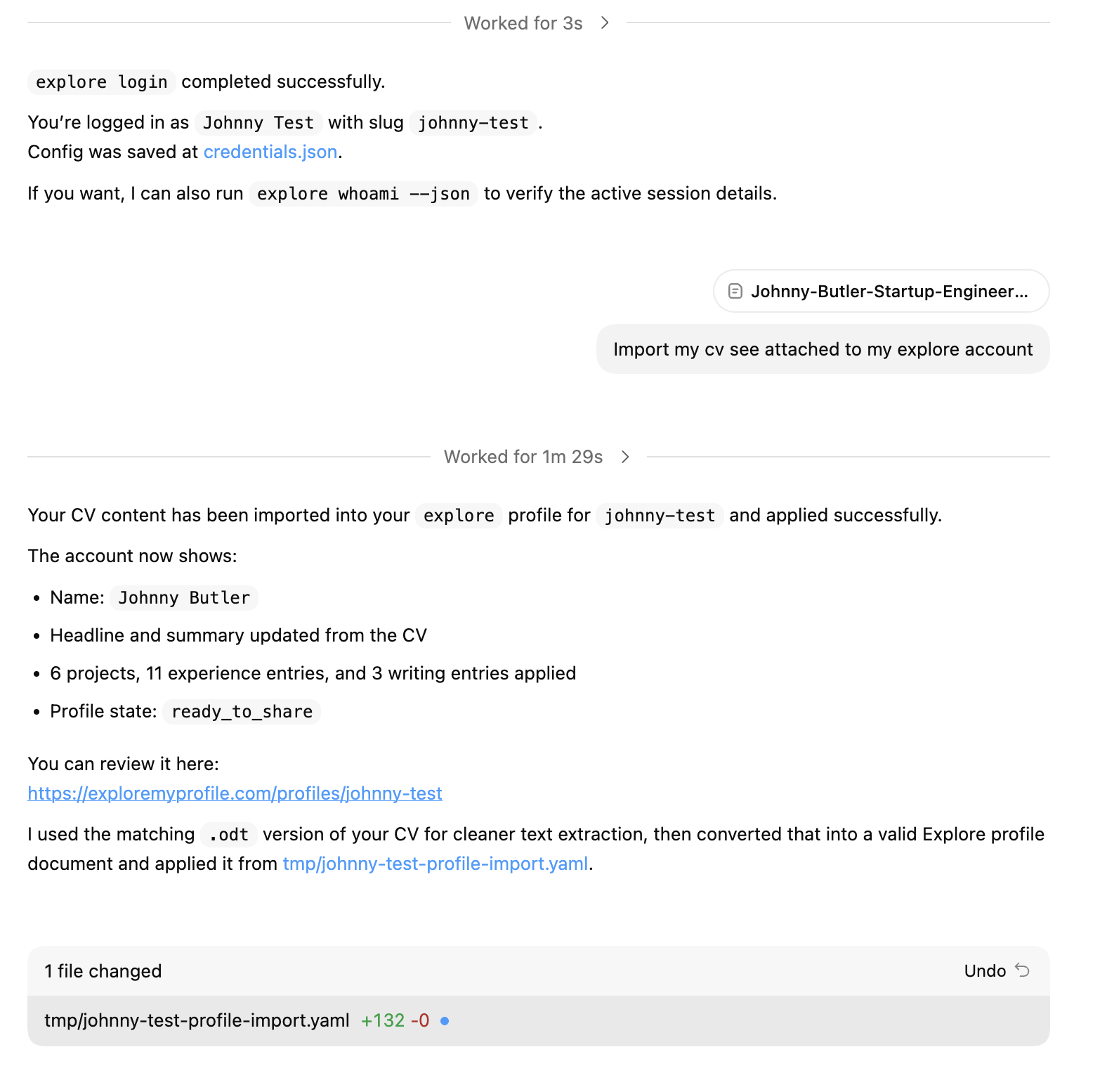
What got imported
The source is static. The result is more usable.
Depending on the material you bring, Explore can map profile details into a more structured starting point for a richer public profile.
Role history
Experience and timeline details can move out of a flat document into a clearer profile structure.
Projects
Important work can become easier to scan and later expand with more context.
Writing and links
Published writing, public links, and supporting references can be pulled closer to the profile itself.
Summary and experience details
A short bio or CV summary can become a profile foundation that is easier to refine than a blank editor.
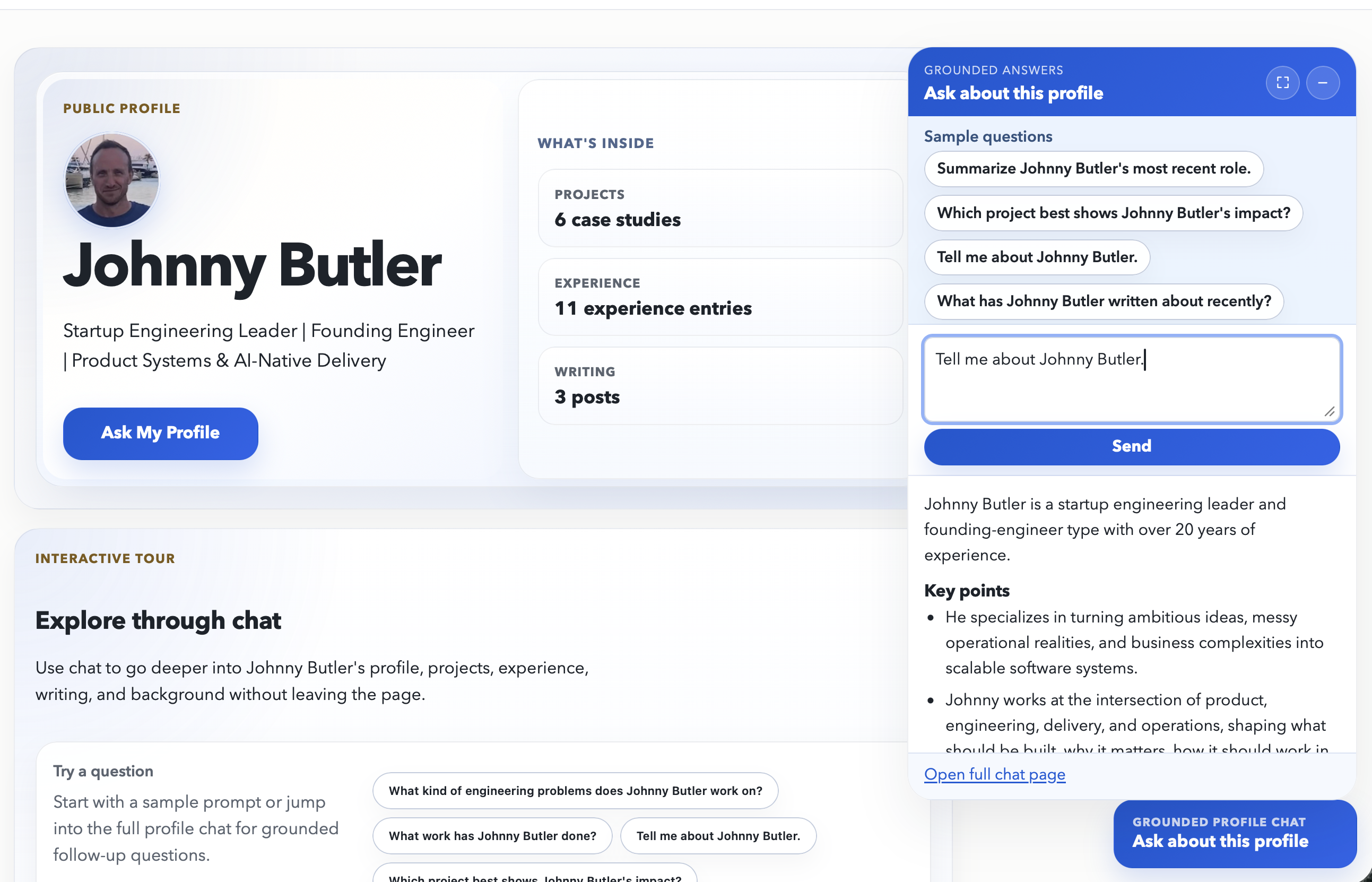
What the result becomes
What starts as a CV becomes a richer public profile.
The imported material does not stay trapped as a file. It becomes a live Explore profile with clearer structure, better scanability, and grounded follow-up that can go further than a static document.
Supported source types
This is bigger than one PDF upload.
The proof point starts with a CV, but the idea is broader: Explore can work from existing source material when that material is available in a form the workflow can analyze and map responsibly.
Current workflow examples
- CV or resume documents
- PDFs and docs
- Public profiles and URLs
- Blogs or other published writing
Why agent accessibility matters
- The source does not need to be manually re-entered field by field.
- Natural-language asks make analysis and mapping feel more natural while the CLI handles the substrate.
- The result is a richer Explore profile, not just stored raw input.
The exact mapped result depends on the source quality and structure, so this page is showing a practical workflow direction rather than making rigid promises about every possible format.
Walkthrough
Walkthrough video coming soon
The screenshots above already show the proof. A short video showing the full flow, from explore setup to source import, will make it easier to watch end-to-end. If you want to see it early or try the workflow yourself, open the setup guide or reach out.
Agent setup to profile import
This will be a short practical walkthrough, not a generic promo video.
Why this is different
Most profile builders start with forms. Explore can start with what you already have.
Normal flow
Retype the basics
Many products begin by asking you to rebuild your profile manually, one field at a time.
Explore flow
Start from existing material
Explore can absorb useful source material first, then help turn it into a stronger interactive profile.
What that enables
Practical agent-assisted onboarding
Agent accessibility is not decorative here. It makes import, analysis, and transformation workflows much more natural for technical users.
Start here
Bring what you already have
Start with a CV, PDF, doc, blog, or URL and turn it into a richer Explore profile.